
APRIL 2026 -PICTURES AND STORIES FROM OUR ARCHIVES - LISBON TOWN HALL AND OPERA HOUSE
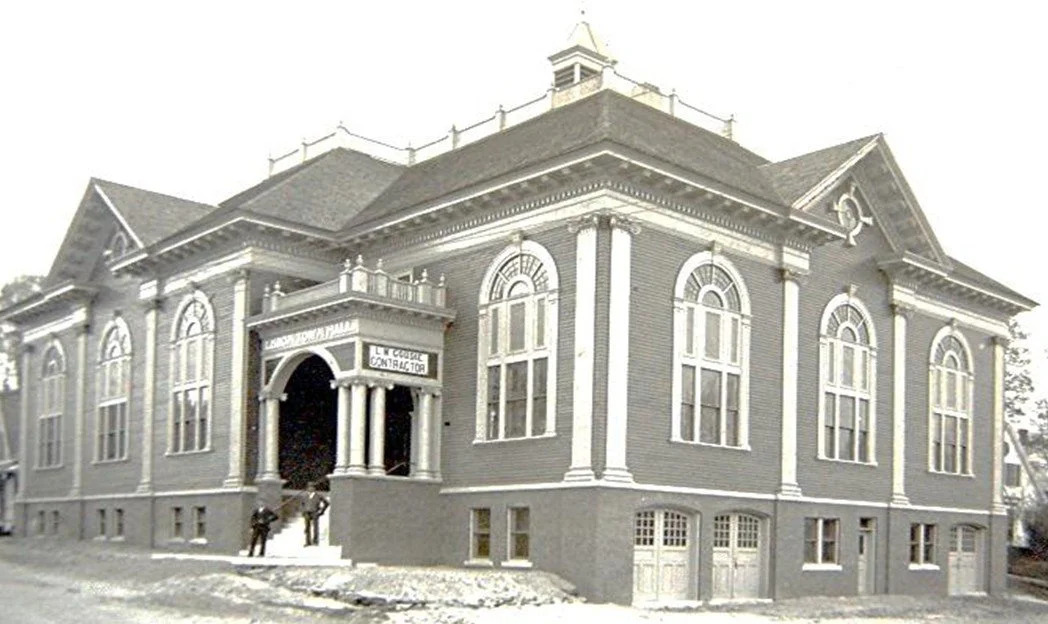
The new Lisbon Town Hall and Opera House pictured when completed in 1902
At the 1901 Lisbon Town Meeting, it was voted, without opposition, that a new town hall should be built. The opposition came later. A committee comprised of selectmen and prominent Lisbon businessmen decided it should be built as a “block” with stores on the first floor and the town hall on the second floor, the same plan as the old own hall which rented space above Wells & Woolson General Store built in 1860 in Lisbon Square. The committee set its sights on a prime house lot at the south corner of South Main Street and Depot Street owned by C. J. Kelsea. They offered him $4,000, but Kelsea wanted $6,000. Then the town threatened to condemn Kelsea’s property and take it over. In the meantime, Grafton County Superior Court, through an injunction, stopped the plan since a municipal building with retail establishments was against the law.
Augustus A. Woolson, one of the most prominent men in Lisbon had been in favor of building on the west side of the river, where it would only cost $1,000 for a lot, and that is where it finally happened. In July of 1901, the lot at the corner of School and Water Streets was being prepared and cleaned up. Lisbon judge, A. C. Wells bought the house and barn that stood on the lot. He moved the house to the end of Meadow Lane, and the barn he moved and attached to a house he already owned on Meadow Lane.
In August, digging began for a foundation, and the stonework was started. A special meeting was held to determine if it was necessary to have the fire department housed in the new town hall instead of a hose house on North Main Street. This was during the time the design was being decided upon. Several architects’ drawings were adapted by Lisbon architect and builder, Sylvanus D. Morgan, a member of a building committee.
Bids went out, and the contract was given to the lowest bidder, Lawrence W. Goudie of Lisbon. By October, construction of the brick walls was started. Then, Lisbon was dealt an awful blow. On November 3, 1901, a fire broke out at Moore’s Peg Mill along the riverbank, and it spread quickly destroying the entire business district on the west side of South Main Street from the School Street Bridge past Central Street. Wells & Woolson’s general store in Lisbon Square was consumed by the fire which included the old town hall which was housed on the second floor. A meeting was quickly held to decide if construction of the new town hall should be suspended in favor of having a new town hall in one of the buildings that would be built on the ruins. It was decided to continue with construction on the west side of the river.
In December, the Town advertised it would receive sealed bids for the whole or part of $30,000 worth of bonds issued for the purpose of erecting a new town hall. Work continued through the winter and spring. At the same time, Lisbon was rebuilding on the ruins with the Parker Block, Boynton Block, Bank Block, and The Moulton.
According to a mid-1990s inventory by the N.H. Division of Historical Resources, Lisbon’s town center is unique, as many places in New Hampshire were economically depressed during that time, and construction of that scale was very unusual.
The new town hall and opera house building was painted red and white and trimmed with fluted pilasters with Ionic capitals. The pilasters support a full frieze with dentils above, an excellent example of the Colonial Revival style so popular at the time. AND, it boasted the largest performance stage in the North Country at the time and a spacious auditorium with a balcony known as the “golden horseshoe” (removed in 1957 to allow for more space for basketball games to be played). The seating capacity of the opera house was over 900. The 12 front entry steps up to the hall are granite from Ryegate, Vermont. A painted stage curtain with a scene of Venice was ordered to adorn the stage and arrived by train at the Lisbon Depot.
The cost of construction was $31,000, and Lawrence Goudie proudly put a sign on the side of the entrance advertising “L. W. Goudie, Contractor.”
The grand opening of the new town hall was on Monday, May 19, 1902, with a fabulous production of William Brady’s drama, Way Down East. Lisbon’s opera house was the only one in the North Country large enough to accommodate such a production. Imagine the excitement in town. A mammoth scenery car with the stage manager and four workers came into Lisbon Depot on the early train followed later by the 26-member company and orchestra. Every seat in the house was sold, and there was standing room only. One person is quoted with saying, “Is this Lisbon?” A full orchestra was playing, and the large production included four changes of scenery, including a famous snowstorm scene. Ticket sales amounted to $750, which went towards the purchase of a piano for the hall.
The building immediately became the center of our community and over the years housed municipal court, police, jail, fire/ems, and town administration and used by schools, social, service, religious, and political organizations for meetings, holiday celebrations, lectures, exhibitions, rallies, plays, concerts, dances, talent shows, fairs, contests, suppers, basketball practices and games, proms, recitals, and private celebrations. Today, the Police Department is housed in the ground level space. Due to accessibility issues, the Town Clerk, Administrative Assistant, and Selectboard now share the Lisbon Fire & EMS building on South Main Street. Town Meeting and voting is held at Lisbon Regional School. Selectboard, Zoning, and Planning Board public meetings/hearings are held in the Lisbon Historic Railroad Station. NH Division of Historical Resources has determine that the Lisbon Town Hall is eligible for both the State and National Register.